%%{init: { "flowchart": { "htmlLabels": false } }}%%

flowchart LR
  Q[Question]
  M[Method]
  R[Results]
  Y[Meaning]
  Q --> M --> R --> Y
8 Technical Writing
“Verbosity to hide ignorance will not be rewarded.”
– Max Mintz (personal communication)
The following short, practical guide will help you meet the expectations set out in the technical writing rubric used in this module (see Appendix A). The rubric focuses on six criteria: narrative, self-consistency, reproducibility, logical flow/coherency, structure, and attribution.
8.1 Narrative
Goal: tell a clear story
Motivate the task, explain the approach, interpret the results, and connect every calculation, figure, or table to what it shows and why it matters.
ImportantNarrative implies writing
Note that narrative involves putting words on paper (not just equations) to explain, e.g., quantities and figures are connected to ideas.
How to do it
Build using focused and readable parts
Keep your overall narrative tight by building it from focused, readable parts. For each subsection, follow the simple progression in Figure 8.1. The reader first needs to know what you are trying to find (the Question), then how you set about finding it (the Method), what you obtained (the Result), and finally why it matters (the Meaning). Repeating this pattern makes your writing predictable, easier to assess, and simpler to debug when numbers or logic do not line up. In longer pieces, this mini-cycle scales up to shape the overall structure of your document (see Section 8.5).
NoteA problem: Delivery van ETA
Estimate a delivery van’s arrival time from app data that includes previous deliveries and a map. The van is roughly 4.5\,\mathrm{km} away.
Begin each subsection by stating the Question plainly, with enough context to be meaningful. Consider what quantity or claim are you after, under which conditions, and why is it useful. For example: “We aim to calculate the average velocity of the van so we can estimate the arrival time.” Next, move to the Method, naming the model or relationship you will use, the assumptions that make it reasonable, and the inputs. Show the key equation or algorithm and define symbols and units; mention tools if relevant. For instance: “From the app we see the van covered d=3.0~\mathrm{km} in t=12~\mathrm{min}; assuming roughly constant speed we use v=d/t.” Then present the Result succinctly. This will typically be a numerical or symbolic outcome, with correct units and sensible significant figures, and a brief note on uncertainty if appropriate. For example, “The calculation gives v=\frac{3.0~\mathrm{km}}{12~\mathrm{min}}=0.25~\mathrm{km\,min}^{-1}\approx 15~\mathrm{km\,h}^{-1} (about 4.2~\mathrm{m\,s}^{-1}).” Close with the Meaning. This involves interpreting the result relative to the question, compare it with an expectation or limit, note any limitations, and point to supporting figures or tables: “At this pace the remaining 4.5~\mathrm{km} will take \frac{4.5}{15}\,\text{h}=0.3\,\mathrm{h}\approx 18~\mathrm{min}\,, which is reasonable and below local speed limits.”
TipVariants
For a proof-style task, “Result” may be a statement proved and “Meaning” explains how the lemma/theorem advances the overall goal. For a coding task, “Method” should include algorithm steps and parameters; “Result” should include the output and a brief performance or accuracy note; “Meaning” comments on whether the output is reasonable and how it supports the objective.
Captions
Every figure or table answers a question you pose in the text. Include the answer in the caption (not just a label).
NoteExample
Consider the following plot of a the height of a falling ball, subject to gravity, over time together with a fit to a quadratic curve.
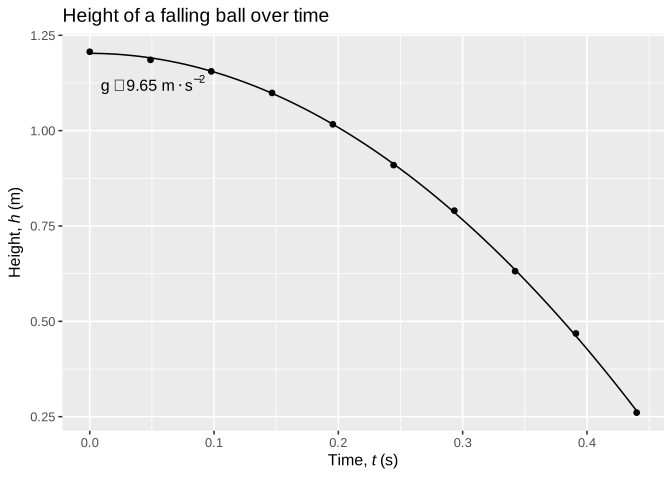
The caption above in Figure 8.2 provides context (describes what the figure is showing) and emphasises the importance of the figure (the mismatch between the experimental observations and expectations).
Interpret
After equations or code outputs, explain what the numbers mean relative to the question.
NoteExample
“Using F=kx with k=200~\mathrm{N\,m^{-1}} and x=0.03~\mathrm{m}, the force is 6~\mathrm{N}, which is enough to hold the mass in place.”
The emphasized text above helps to explain the practical significance of the calculation.
WarningDon’t dump!
Avoid the urge to provide superfluous information and make sure that equations, figures, and tables are necessary to support the narrative.
8.2 Self-consistency
Goal: make everything agree
Calculations, figures, tables, and symbols should all match with the textual narrative, and any units and definitions should be used consistently throughout the text. Ensure that equations and figures support your narrative.
A small checklist
Consider the following points when reviewing a text for self-consistency.
- Symbols: Define once, and use consistently (for example, v is always speed; do not switch to u later).
- Units: Use SI units, unless there is a compelling reason not to. When typesetting, use a non-breaking space between number and unit (for example,
3.2\,\mathrm{m}\,\mathrm{s}^{-1}in LaTeX). Avoid writing “3.2m/s” in a formal piece of writing (it is fine for scratchwork). - Significant figures: Reflect measurement precision and propagate appropriately. Do not over-round at intermediate steps.
- Figure axes: Units and symbols on every axis (for example, Time, t (s)). Match variable names to the text.
- Tables: Include units in headers, not in every cell.
- Numerical agreement: Values quoted in text equal those shown in figures/tables (including the same rounding).
Style conventions
Style conventions are very important when typesetting technical documents using LaTeX. Pick a style and use it throughout your piece of text. For example, common style conventions are:
- Scalars/variables: italic (x, t, E); vectors: bold (\mathbf{v}); matrices: bold caps (\mathbf{A}).
- Functions/operators (\sin, \cos, \exp) upright; units upright (\mathrm{m},\,\mathrm{s}).
- Population vs estimates (statistics): many styles are possible, such as using Greek letters for population parameters (\mu, \sigma, \rho) and Roman letters for corresponding estimates (m, s, r), or decorating corresponding estimates with hats (\hat{\mu}, \hat{\sigma}, \hat{\rho}).
8.3 Reproducibility
Goal: ensure someone else can verify your findings
Provide enough detail (steps, parameters, tools) so that someone else can replicate your results and findings. This includes defining notation when first used in a text and including units as appropriate.
ImportantReproducibility crisis
As a future mathematician or physicist, please promote positive behaviours and avoid contributing to the reproducibility crisis in science [Ioannidis (2005)].
Minimum to include
- Method steps: Numbered steps for key procedures or algorithms.
- Parameters and inputs: List parameter values, initial conditions, and data sources. State any random seeds.1
- Tools: Name software and versions, for example, “Python 3.11, NumPy 1.26; plots made in Jupyter”.
- Data and code access: If provided, give file names or appendix listings; if not, describe how data were generated, for example, “Measured height with a meter rule” or “three repeated measurements per subject”.
- Assumptions and approximations: State and justify, for example, “Neglect air resistance” or “small-angle approximation valid for \theta<10^\circ”.
Notation discipline
Define all symbols when first introduced.
NoteBad Example
This is an example of what not to do.
From kx = F we found 6, so k = 200 and then we used u=kx.
Problems: symbols are introduced without definitions, units are missing or informal, and the symbol switches from k to u mid-calculation.
NoteGood Example
This is an exmaple of good practice.
Let k denote the spring constant (\mathrm{N\,m^{-1}}). By Hooke’s law, F = k x \,, where F is the force (\mathrm{N}) and x is the extension from equilibrium (\mathrm{m}).
Notice how all notation is defined and units are provided.
8.4 Logical flow/coherency
Goal: guide the reader
Organise your work so each step follows naturally from the last, and use brief transitions to steer the reader between equations and ideas rather than leaving logical jumps.
Structure each section with transitions
To demonstrate that you meet expectations against this goal, use words or phrases to guide transitions between steps in your calculations. This includes explaining how each result shapes the argument and, for example, why one line follows from the next. When you present calculations, explain how the method yields numbers. Be sure to follow results with interpretation so the reader understands what the results mean.
WarningAvoid common flow breakers
It is easy to break the logical flow of a piece of technical writing. Some common pitfalls to avoid are:
- Introducing symbols in a figure without defining them in text.
- Presenting equations with no statement of purpose.
- Jumping from raw data to conclusions without intermediate reasoning.
- Switching units or symbols mid-way (for example, metres to centimetres without saying so).
8.5 Structure
Goal: headings, sentences, captions
Use full sentences and informative headings to structure your document. Include labels for equations, figures, and tables as appropriate. Be sure that any numbered equation and figure/table is referenced in the text narrative.
Suggested problem solution outline
Adapt this suggested outline for short pieces of writing, such as solutions to module problems, as needed. Below we list a part or section of the report and what it should contain. Note how this structure mirrors the problem solving framework introduced in Chapter 2.
- Problem statement: rewrite the problem in your own words. Provide context, objective, and a brief roadmap of the solution.
- Method: state the model/assumptions, derivations, algorithm, and parameters used. Indicate which heuristic guides the method.
- Solution: provide the result with a short interpretation.
- Conclusion and Discussion: explain what the results mean, note limitations or possible generalisations, and reflect on why the heuristic worked (or why others did not).
Suggested lab report outline
Adapt this suggested outline for a lab report or longer piece of writing as needed. Below we list a part or section of the report and what it should contain. Not all parts are equal. Titles should be short and snappy; a method section should be as long as needed to ensure reproducibility.
- Title: concise and informative
- Abstract (3–5 sentences): problem, method, key result, implication
- Introduction: context, objective, roadmap of the report
- Methods: list of equipment/materials used, step-by-step description of experiment, description of data acquisition process, model/assumptions, derivations, algorithm, parameters;
- Results: tables/figures with brief interpretation of raw and processed data
- Analysis and Discussion: use processed data to test hypotheses or compare with theory, describe what the results mean, limitations, sensitivity
- Conclusion: answer the question and outline next steps
- References: consistent style (for example, author-year or numbered)
- Appendix: code listings, extended derivations, raw data description
8.6 Attribution
Goal: give credit and highlight your contributions
Cite sources of ideas, data, figures, and methods. Be sure that someone reading the document can distinguish your work from external material.
Practical rules
- Cite where used: immediately after the relevant sentence/equation, for example, “Using Hooke’s law [1] …”.
- Quoting vs paraphrase: prefer paraphrase with a citation. Quote sparingly with quotation marks and a page number where appropriate.
- Your contribution: signal it explicitly, for example, “We implement the method of [2] and add a sensitivity analysis”.
- Figure reuse: if reusing or altering a figure, state the source and permission status.
- Reference style: use one consistent style and include all necessary metadata so that someone reading your text can easily find the source.
We will use simulation in later modules, such as MA22004; stating the seed lets others reproduce your numbers exactly when including (pseudo)random draws.↩︎